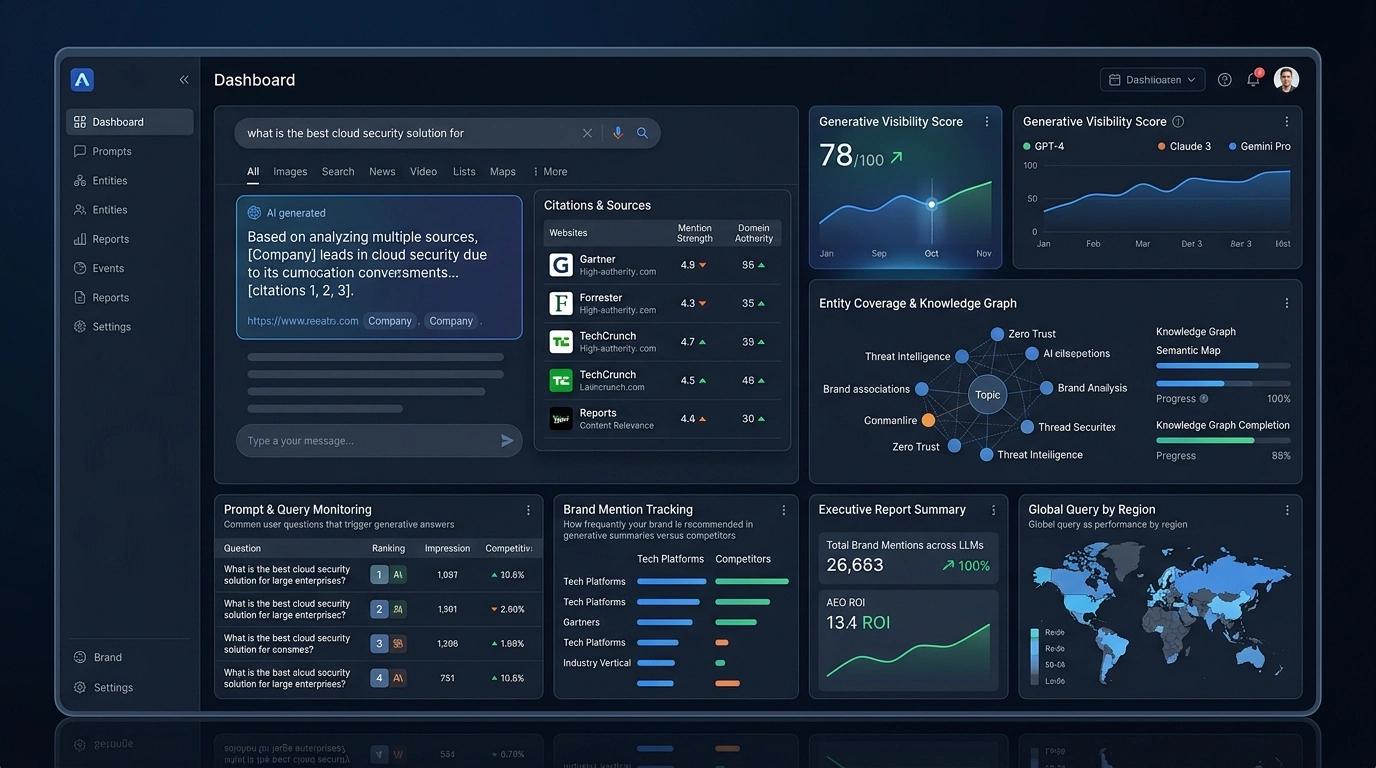
The way people search online is changing fast. Where search engines showed mainly a list of blue links for years, users now increasingly get an AI-generated answer straight at the top of the page.
That changes the rules of the game for online visibility.
Scoring well in Google alone is no longer enough. Your content must also be selected as a source in the AI answers of search engines and tools such as ChatGPT, Gemini and Perplexity.
That is where GEO comes in: Generative Engine Optimization.
GEO is about optimising your content so that generative search engines use your website as a reliable source of information. Not only to rank, but to actually be mentioned and used in AI summaries.
For companies that want to stay visible online, this is not a distant prospect. It is happening already.
What is GEO?
GEO stands for Generative Engine Optimization.
Where traditional SEO focuses on positions in search results, GEO focuses on visibility in AI-generated answers.
AI systems analyse content differently from classic search engines. They look not only at keywords, but mainly at:
- depth of content
- clear structure
- trustworthiness
- author expertise
- semantic context
- technical clarity
So the question is not only: can Google find your page? But above all: does an AI model want to use your content as a source?
Why is GEO important now?
Users increasingly get a direct answer in the search environment, without clicking through to websites. As a result, visibility shifts from a click to a mention.
For companies, this means that brand visibility, authority and organic traffic increasingly depend on whether AI systems trust your content.
Whoever invests in GEO now builds a head start. Not only in visibility, but also in brand authority and thought leadership.
When your content comes back in AI answers, you automatically position your brand as an expert within your field.
How do you start with GEO?
A strong GEO strategy starts with four concrete pillars.
1. Structured data
Use schema markup to make context explicit. Think of structured data such as:
- Article
- FAQPage
- Person
- Organization
- HowTo
This helps search engines and AI systems better understand what your content is about and who the sender is.
2. Show expertise
AI looks not only at the content, but also at the source. So make clear:
- who the author is
- what expertise someone has
- which experience is relevant
- which cases or publications are related
Strong author pages and clear expertise signals strengthen your E-E-A-T profile.
3. Write in a question-and-answer structure
AI systems process content well when it matches natural search questions. So use clear subheadings such as:
- What is GEO?
- What is the difference between SEO and GEO?
- How do you make sure AI uses your content?
Answer every question concretely and with substance.
4. Build E-E-A-T
Modern visibility is about trust. So show:
- experience through cases and practical examples
- expertise through in-depth content
- authority through consistent publications
- trustworthiness through transparent company information
This increases the chance that your content is selected as a source.
GEO is more than SEO
GEO is not a replacement for SEO, but an extension.
SEO makes sure you are found. GEO makes sure you are used.
Companies that invest in both now build lasting online visibility in an AI-driven search landscape.